Why the paper logbook is now a liability in UAE offices
The paper logbook at reception feels simple until a regulator asks hard questions. Under the UAE PDPL, every visitor entry with a name, mobile number, or Emirates ID becomes personal data, and leaving that logbook open on the counter is a data protection risk you personally own. For any office manager in a Dubai or Abu Dhabi tower, that risk now sits right next to the coffee machine.
Think about a typical office visitor arriving in a mixed use building in Dubai or in a free zone like DIFC or ADGM, where building management already expects accurate headcount data for fire safety and evacuation drills. The old visitor management habit of asking guests to sign a paper sheet in arabic or in English, then tearing off pages for security, creates gaps in your audit trail and makes any later check on who was inside almost impossible. A digital visitor management system for a UAE office replaces that chaos with a structured management system that timestamps every system visitor entry and exit in seconds.
Compliance is not the only driver, but it is the one that gets leadership attention. When you run a reception desk in Dubai Sharjah corridor offices or in Sharjah Ajman industrial zones, you already see how often external auditors, insurers, and even clients ask for proof of access control and security procedures. A modern visitor management platform, whether a simple iPad kiosk or a more advanced set of systems integrated with building access, gives you a single source of truth for all visitors and turns your reception from a friendly chaos point into a controlled security perimeter.
Many Arabian Emirate companies still treat visitor management as a hospitality ritual rather than a governance process. That mindset made sense before PDPL and before regional regulators started aligning with Saudi Arabia on stricter data protection enforcement, but it now leaves offices exposed on multiple fronts. A digital visitor management system in a UAE office is no longer a nice to have software upgrade, it is a core management software control that protects both people and données in a way a paper book never can.
What a compliance ready visitor management stack looks like in the UAE
Start with the minimum viable stack for a visitor management system in a UAE office, then layer in integrations as your risk profile grows. At the front line you need a tablet based kiosk that supports both Arabic English interfaces, so every visitor can check in without friction while still accepting your PDPL consent text. That kiosk should run reliable visitor management software such as Envoy, SwipedOn, or Tekvisit visitor modules, all of which can operate as stand alone systems or plug into broader management systems.
On the back end, your management system must treat visitor data as sensitive, not as a casual guestbook, which means role based access, retention rules, and clear deletion procedures aligned with UAE PDPL guidance. In practice, that means your office visitor records from Dubai, Abu Dhabi, Ajman Abu industrial sites, or even cross border Saudi Arabia branches are stored in a secure software UAE environment, with encryption at rest and in transit, and with access control logs that show exactly which receptionist or security officer viewed which record. If your current system in the UAE is just a shared Excel file on a public drive, you already know that does not meet any serious data protection standard.
Governance is where most offices quietly fail, because they deploy a shiny system visitor app but never define procedures. You need a written visitor management policy that covers pre registration, ID check rules, badge printing, emergency evacuation reporting, and incident escalation, and that policy should be part of your wider AI and data governance framework, the same way this governance gap analysis for UAE offices treats AI tools. When your visitor management software, your access control systems, and your reception équipe all operate under one documented management system, you can face auditors, landlords, and insurers with confidence instead of hoping nobody asks to see last month’s logbook.
From a practical standpoint, the tech stack does not need to be complex or expensive. A single iPad at reception, a stable Wi Fi connection, and a cloud based management software subscription often costing less than a premium coffee machine per month are enough to run a robust visitor management solution across multiple systems UAE locations. The real upgrade is not the hardware, it is the shift from ad hoc reception habits to a repeatable management process that treats every visitor as part of your operational data, not just a name on a page.
Fire safety, headcount accuracy, and real time visibility across UAE sites
When a fire alarm goes off in a Dubai high rise or an Abu Dhabi campus, the first question from building security is simple, yet brutal. Who is inside right now, including contractors, delivery riders, and short term visitors who never received permanent access cards. If your only answer is a half completed paper sheet at reception, you have already failed the basic test of safety management.
A digital visitor management system in a UAE office gives you real time occupancy data that can be exported in seconds during an evacuation, which is exactly what building management in DIFC, ADGM, and major Dubai Sharjah business parks increasingly expects. Every visitor check in at the kiosk, every manual entry by reception, and every pre registered guest arriving from Ajman or Sharjah Ajman industrial zones is logged with time, host, and purpose, so your fire warden can run a quick headcount against the system visitor list at the assembly point. That level of visibility is not a luxury feature, it is a core safety control that aligns with how serious landlords and insurers think about risk.
Contractor and delivery tracking is the second blind spot that a proper management system closes. In many Arabian Emirate companies, maintenance teams, IT vendors, and cleaning crews move between Dubai, Abu Dhabi, and Ajman Abu facilities with minimal oversight, often using generic access cards that bypass normal access control rules, which makes later incident investigations painful. A structured visitor management solution forces every external worker to register, accept safety rules in Arabic English, and receive time bound access, so your management systems can show exactly who was in which zone at any moment.
For smaller offices and non profits sharing floors in mixed use towers, the same logic applies, even if the scale is modest. A lean visitor management software setup, similar in spirit to the database tools evaluated in this guide on choosing database software for small UAE offices, can still provide accurate headcounts and evacuation lists without heavy infrastructure. The key is to treat visitor data as operational data, with clear KPIs for evacuation readiness and incident response, rather than as a hospitality formality that nobody ever reads after the visit ends.
Evaluating visitor management software options by budget and complexity
Office managers often overestimate the complexity of moving from a paper logbook to a digital visitor management system in a UAE office. In reality, the market now offers clear tiers of management software, from low cost apps to enterprise grade systems integrated with building automation, so you can match your budget and risk profile without drama. The trick is to evaluate each option against your real workflows in Dubai, Abu Dhabi, Ajman, and any Saudi Arabia branches, not against a glossy feature list.
At the entry level, cloud based visitor management tools such as Envoy or SwipedOn provide a simple kiosk interface, QR based pre registration, NDA signing, and host notifications, often starting around a few hundred dirhams per month, which is less than many offices spend on coffee capsules. These systems uae friendly tools can run on a single iPad, support Arabic English screens, and integrate with basic access control systems through APIs, which already puts you far ahead of any paper based management system. For slightly more complex environments in Dubai Sharjah logistics hubs or Sharjah Ajman industrial clusters, mid range solutions like Proxyclick or Teem add deeper analytics, multiple entrance management, and richer reporting for PDPL and data protection audits.
Enterprise environments, especially in critical infrastructure or large campuses, often pair visitor management with building management systems from vendors such as Honeywell or Lenel, or with security platforms like Tektronix that already manage CCTV and badge access. In those cases, the visitor management software becomes one module in a broader management systems architecture, feeding real time visitor data into access control dashboards and emergency response tools. Tekvisit and similar tools can act as the front end kiosk layer, while the core system UAE infrastructure handles identity verification, long term storage of visitor records, and integration with HR or contractor databases.
Whatever your tier, insist on three non negotiables when you evaluate any visitor management solution. First, PDPL ready data protection features, including configurable retention periods and clear export or deletion workflows for uae visitor records, because regulators will eventually ask how long you keep those données. Second, transparent pricing that covers all office visitor locations you manage, from a single Abu Dhabi office to multiple systems UAE branches, so you can present a clean ROI case to your leadership without hidden costs undermining your stratégie.
Implementation playbook for UAE office managers: from pilot to daily discipline
Rolling out a visitor management system in a UAE office is less about technology and more about procedure. A focused pilot on one reception desk in Dubai or Abu Dhabi, with a single iPad kiosk and a clear script for receptionists, can validate your workflows in a week. The goal is not a perfect system on day one, it is a usable management system that your équipe can refine through real visitor interactions.
Start by mapping your current visitor flows, from pre scheduled client meetings to walk in candidates and ad hoc contractors, and write down every step where reception currently improvises. Then configure your chosen visitor management software to reflect those flows, including pre registration links in calendar invites, on screen PDPL consent text in both Arabic English, and automatic host notifications via email or Microsoft Teams, so the system visitor journey feels natural rather than forced. A short 30 minute training session is usually enough for reception staff to handle check ins, troubleshoot basic issues, and explain the new process confidently to visitors.
Next, align your visitor management procedures with your wider security and data protection governance. That means agreeing with your security team on ID check rules, badge color coding, and access control zones, and aligning with your legal or compliance colleagues on PDPL retention periods for uae visitor records, especially for sensitive sites in Dubai Sharjah logistics corridors or Ajman Abu industrial facilities. Document these rules in a simple playbook, share it with all front office and security staff, and review it quarterly, the same way you would review any other management systems policy that affects daily operations.
Finally, treat visitor management as an ongoing operational KPI, not a one off tech project. Track metrics such as average check in time, percentage of pre registered visitors, number of rejected entries due to failed security checks, and time to produce an evacuation list during drills, then present those résultats to your leadership as part of your broader office management dashboard. When visitor management, access control, and PDPL compliance show up as a clear P&L line rather than a vague vibe survey, your role as an office manager shifts from gatekeeper to operational strategist.
FAQ
What is a visitor management system in a UAE office context ?
A visitor management system in a UAE office is a combination of software, hardware, and procedures that controls how visitors enter, move through, and exit your premises. It replaces paper logbooks with a digital kiosk or tablet, captures visitor data under UAE PDPL rules, and integrates with access control systems to manage badges and permissions. For office managers, it becomes a central management system for security, compliance, and real time occupancy visibility.
How does a digital visitor system help with UAE PDPL compliance ?
A digital visitor management solution helps with UAE PDPL compliance by controlling who can access visitor data, how long it is stored, and how consent is recorded. The software can present privacy notices in Arabic and English, log explicit consent, and enforce retention periods so old visitor records are deleted automatically. This is far safer than a paper logbook, where anyone can see previous entries and where data protection rules are almost impossible to enforce consistently.
What hardware do I need to start with digital visitor management ?
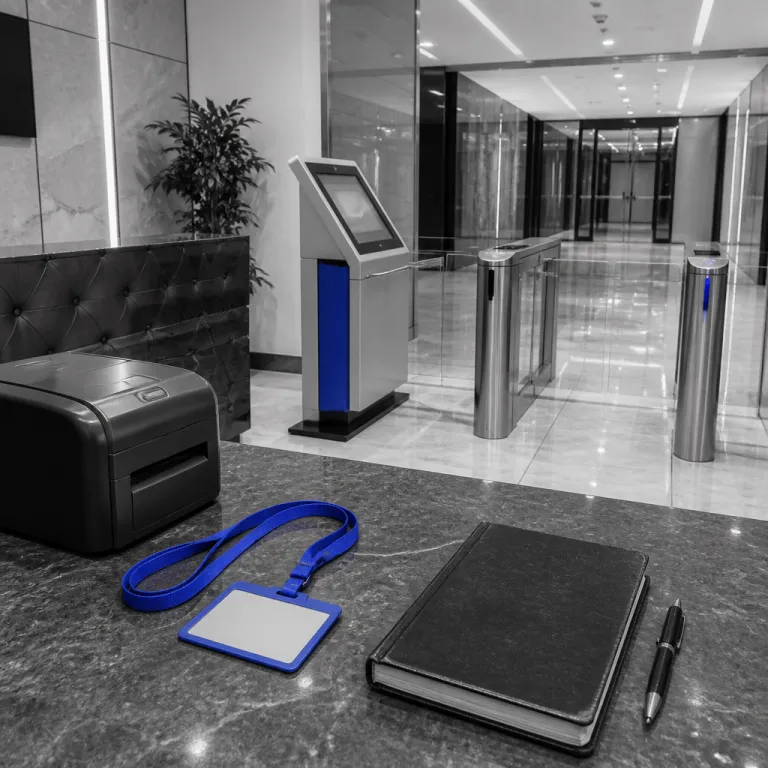
Most UAE offices can start with a single tablet, usually an iPad, mounted as a kiosk at reception, plus a small badge printer if you want physical passes. The visitor management software runs in the cloud, so you mainly need stable internet access and a secure Wi Fi network. Over time, you can integrate the system with existing access control hardware such as turnstiles or door readers if your building supports it.
Can small offices in Dubai, Abu Dhabi, or Ajman justify the cost ?
Small offices can usually justify the cost because entry level visitor management software often costs less per month than office refreshments or parking allowances. The ROI comes from reduced compliance risk, faster check in times, and better visibility during emergencies or audits. For many SMEs, the ability to show landlords and insurers a proper visitor management process is already worth more than the subscription fee.
How long does implementation and staff training usually take ?
Implementation for a basic visitor management system in a UAE office typically takes a few hours for configuration and testing, followed by a short pilot period. Reception staff and security teams usually need 30 to 60 minutes of hands on training to become comfortable with check in flows, troubleshooting, and explaining the process to visitors. The bigger effort is updating your written procedures and aligning them with PDPL and security requirements, which can be done over a few working sessions with stakeholders.