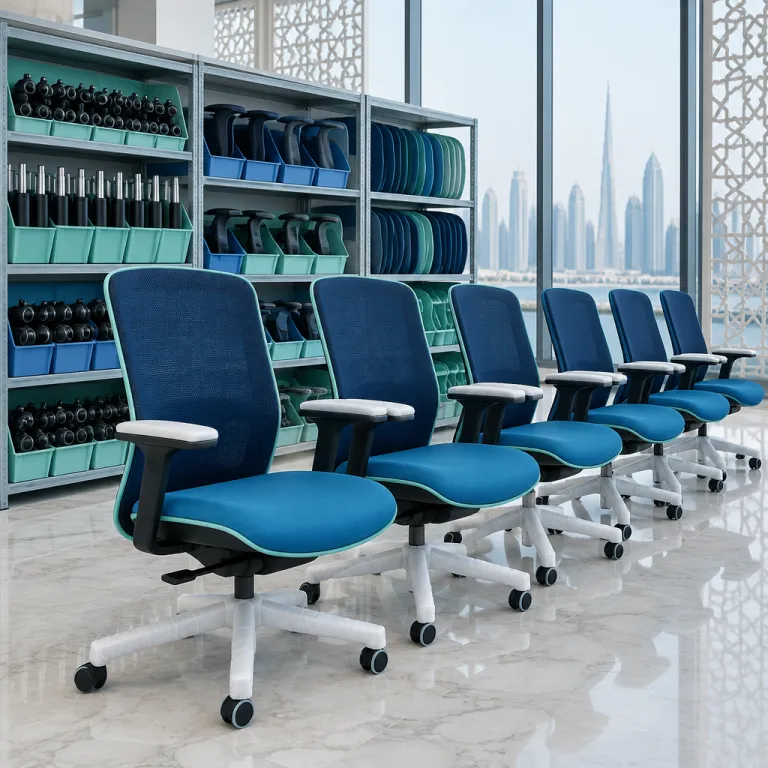
Why office chair components matter in UAE workplaces
Every office manager in the UAE feels the impact when an office chair fails unexpectedly. In a duty office environment where teams rotate across shifts and heavy-duty workloads are common, poorly specified office chair parts quickly turn into safety risks and hidden costs. Treating each chair, each mechanism, and each set of casters as a long-term asset rather than a disposable consumable changes how you negotiate with service providers and how you plan replacement cycles.
In climate-controlled towers from Dubai Marina to Abu Dhabi Global Market, the combination of air conditioning and fine dust affects gas lift performance, chair gas seals, and the durability of each gas cylinder. When the gas cylinder or lift cylinder loses pressure, staff instinctively over-adjust the tilt control and the control mechanism, which accelerates wear on the tilt and swivel functions. A structured inspection routine for chair parts, including the chair base, furniture casters, and every chair arm, helps you decide whether you need full chair replacement or targeted replacement parts only.
Service providers often propose a standard office chair package with limited options for base replacement, arm pads, or a specific gas lift specification. That approach rarely fits a mixed portfolio of meeting rooms, focus areas, and heavy-duty task zones where each chair base and each set of furniture casters faces different loads. By mapping which office chair parts fail first in your own office, you gain leverage on price, on service level agreements, and on the exact mechanism and mounting holes configuration you require from any replacement office contract.
Heavy duty performance and safety standards for chair mechanisms
In UAE companies, health and safety audits increasingly scrutinize every office chair mechanism, from the tilt control to the swivel function and the gas lift. A heavy-duty duty office workstation used by multiple employees needs a certified gas cylinder and a reinforced chair base that can handle higher dynamic loads. When you specify office chair parts only by aesthetic criteria, you risk non-compliant chair components that fail under heavy use and expose the company to liability.
Office managers should request written confirmation of the standard each gas cylinder and each control mechanism meets, such as BIFMA or EN performance levels. For example, the BIFMA X5.1 Office Seating standard (latest revision) and EN 1335 for office work chairs define durability and safety tests that reputable manufacturers follow; detailed requirements are available directly from the respective standard documents and technical summaries published by BIFMA and CEN. This is especially relevant when you sign multi-year service agreements for chair replacement and base replacement with regional vendors that bundle price, maintenance, and free on-site checks. A clear matrix that links each office chair model to its approved replacement parts, including the exact lift cylinder dimensions and mounting holes pattern, prevents technicians from installing incompatible chair gas components during urgent repairs.
For high-traffic areas like reception zones in Dubai International Financial Centre, specify furniture casters with soft treads that protect hard floors and reduce noise. In back-office processing centers where staff sit for long periods, prioritize tilt control mechanisms that allow synchronized chair tilt and adjustable tension, not only basic swivel and height adjustment. When you align safety standards, mechanism options, and service provider obligations, you transform routine chair replacement into a structured risk management tool that supports both employee wellbeing and corporate governance, as highlighted in regional discussions on raising the bar in equipment service management for Arabian Gulf offices.
Service provider management and total cost of chair replacement
Managing service providers for office chair parts in the UAE requires more than comparing a single unit price for an office chair. The real cost emerges from the full set of replacement parts, the frequency of chair replacement, and the downtime when a chair base or gas lift fails without a ready replacement office unit. Office managers who track these data points across multiple towers and free zone locations gain a clearer view of which vendors truly deliver value.
Start by classifying every chair into usage categories such as executive, standard task, and heavy-duty operational, then map which chair parts fail first in each category. You may find that arm pads and chair arm assemblies fail earlier in collaborative zones, while the gas cylinder and lift cylinder fail faster in call centers where staff adjust height repeatedly. With this information, you can negotiate service contracts that include a predefined set of high-risk replacement parts, including furniture casters and base replacement units, rather than paying premium price for full chair replacement every time.
Data quality is critical when you manage multiple service providers across Dubai, Abu Dhabi, and Sharjah, especially if your company operates on a regional or global scale. Standardizing how technicians record control mechanism types, mounting holes patterns, and chair tilt configurations allows you to compare performance across brands and contracts, which aligns with best practices for optimizing supplier data for enhanced business operations. Over time, this structured approach to office chair parts helps you shift from reactive maintenance to predictive planning, reducing emergency calls, improving staff satisfaction, and strengthening your negotiating position with every duty office service partner.
Specifying office chair components for diverse Arabian Emirate workspaces
Different zones in a modern UAE office demand different specifications for office chair parts, even when the visual design appears unified. A client-facing lounge in a Dubai media agency may prioritize elegant chair arms and slim bases, while a back-office processing floor in Sharjah needs heavy-duty chair bases, robust gas cylinders, and durable furniture casters. Treating all these environments as identical leads to premature failure of chair parts and unnecessary replacement costs.
For focus rooms and executive offices, consider office chair models with advanced tilt control and multi-function control mechanisms that support fine-tuning of chair tilt, seat depth, and backrest tension. These mechanisms often use more complex mounting holes patterns and specialized gas lift units, so you must ensure that your service providers stock compatible replacement parts and not only generic gas cylinders. In contrast, training rooms and hot desk areas may function well with standard swivel chairs that use simpler control mechanisms but still require reliable chair gas components and a stable chair base.
In facilities that operate around the clock, such as logistics control centers near Jebel Ali Port, specify heavy-duty office chair solutions with reinforced bases, larger diameter lift cylinders, and high-capacity furniture casters. Here, the duty office environment justifies a higher initial price because the extended lifespan of the chair base, chair arms, and gas lift reduces the frequency of chair replacement. When you align component specifications with real usage patterns, you create a coherent strategy for office chair parts that supports both comfort and financial discipline.
Operational playbook for office managers handling chair repairs and replacements
Office managers in UAE companies benefit from a clear operational playbook that defines when to repair and when to replace office chair components. A simple decision tree that evaluates the condition of the chair base, the gas cylinder, the control mechanism, and the furniture casters helps front-line staff log accurate tickets. This structure also prevents unnecessary full chair replacement when a low-cost set of arm pads or a single lift cylinder would restore full function.
Begin by training your facilities team to perform quick checks on every office chair reported as faulty, focusing on visible cracks in the base, wobbling casters, and any sudden loss of height that indicates chair gas leakage. If the base is intact and the mounting holes for the mechanism are not damaged, a targeted gas lift or gas cylinder replacement is usually sufficient, especially when the swivel and tilt control still operate smoothly. When multiple chair parts show wear, such as loose chair arms, noisy furniture casters, and a misaligned control mechanism, a complete chair replacement may offer better long-term results.
To streamline this process, maintain a labeled storage area with a standard set of replacement parts, including chair bases, gas cylinders, arm pads, and casters suitable for your main office chair models. This enables technicians to perform base replacement or chair arm swaps during off-peak hours, minimizing disruption in busy duty office zones. Embedding these procedures into your service provider contracts ensures that every intervention on office chair parts follows a consistent, auditable workflow rather than ad hoc decisions.
Quick decision table for faulty chairs
| Check | Condition | Action | Notes to record |
|---|---|---|---|
| Step 1 – Safety | Cracked base, unstable seat, or severe wobble | Tag “out of service” and schedule full chair replacement | Chair model, location, date, technician ID |
| Step 2 – Components | Only casters, arm pads, or gas lift fail | Log parts-only repair and replace specific components | Part codes, mounting holes pattern, mechanism type |
| Step 3 – Age and cost | Chair near end of service life and several parts worn | Approve complete chair replacement | Estimated age, repair cost vs new chair cost |
Aligning sustainability, waste management, and office chair component strategy
Sustainability expectations in UAE companies are rising, and office chair parts play a quiet but significant role in corporate responsibility. When you treat every failed gas cylinder, broken chair arm, or damaged chair base as general waste, you increase landfill volumes and miss opportunities for material recovery. A structured approach that separates metal furniture casters, steel bases, and plastic arm pads supports both environmental goals and transparent reporting.
Office managers can work with service providers to implement take-back schemes where each set of replacement parts triggers responsible disposal or recycling of the removed components. This approach aligns naturally with broader workplace initiatives such as smart waste segregation, where solutions like those described in smart liner choices for office waste management in UAE companies show how small operational changes deliver measurable gains. By tracking the volume of chair replacement and base replacement activities, you can link sustainability KPIs directly to procurement decisions about office chair specifications and duty office usage patterns.
In practice, this means preferring office chair parts that allow easy disassembly of the control mechanism, gas lift, and casters, with clearly marked materials that recycling partners can process. It also means challenging service providers on the durability of their standard chair parts and the real duration of their warranties, especially for heavy-duty environments. When sustainability, cost control, and service provider management converge around a coherent strategy for office chair parts, office managers in the UAE gain both operational resilience and stronger ESG narratives for internal and external stakeholders.
Key statistics on office chair components and workplace performance
- According to guidance associated with BIFMA X5.1 Office Seating (latest edition), heavy-duty task chairs are typically tested to higher dynamic load ratings than standard models; published examples from manufacturers referencing this standard indicate test loads in the region of 120–135 kilograms for intensive-use seating versus lower thresholds for conventional office chairs. Exact values vary by product line, so facility teams should verify the certified load rating in the technical data sheet for each chair base used in UAE offices.
- Research summarized by the Chartered Institute of Ergonomics and Human Factors in its guidance on office ergonomics (for example, CIEHF, Working from Home: Staying Healthy, 2020) reports that well-adjusted office chairs with functional tilt control and lumbar support are associated with meaningful reductions in self-reported musculoskeletal discomfort over several weeks of use. Facilities and HSE teams can consult the original CIEHF publication to review the underlying studies and apply the recommendations when maintaining chair mechanisms and gas lifts.
- A facilities management benchmark by IFMA (International Facility Management Association, Operations and Maintenance Benchmarks, 2017) notes that organizations with proactive furniture maintenance programmes, including scheduled inspection of chair parts and furniture casters, report longer average service life for office seating than those relying solely on reactive replacement. The benchmark report provides detailed comparative data that procurement teams can use when building the business case for structured chair inspections.
- Studies referenced by the World Green Building Council in its report Health, Wellbeing and Productivity in Offices (2014) show that improved indoor environmental quality, which includes ergonomic seating and reliable office chair support, can contribute to measurable productivity gains. The WGBC publication consolidates multiple peer-reviewed sources, giving office managers a robust evidence base for investing in high-quality office chair components as part of broader workplace optimisation in Arabian Emirate companies.
FAQ about managing office chair components in Arabian Emirate companies
How often should office chairs be inspected in a duty office environment ?
In a high-use duty office setting, a basic inspection of each office chair every six months is advisable, with annual detailed checks of the gas cylinder, control mechanism, and chair base. For heavy-duty zones with 24/7 operations, quarterly inspections of furniture casters, lift cylinders, and chair arms help detect early wear. These intervals can be written into service provider contracts to ensure consistent execution.
When is it better to replace an entire chair instead of individual parts ?
Full chair replacement makes sense when multiple critical components such as the base, gas lift, and tilt control show significant wear or structural damage. If the mounting holes in the seat plate are cracked or the control mechanism housing is deformed, installing new chair parts may not restore safe performance. In contrast, isolated failures of casters, arm pads, or a single gas cylinder are usually best handled with targeted replacement parts.
What specifications matter most when choosing gas cylinders for Arabian Emirate offices ?
Key specifications include the weight rating, stroke length, and compatibility with the existing control mechanism and chair base. In the UAE climate, selecting gas cylinders from reputable manufacturers with proven sealing performance helps reduce premature chair gas leakage. Office managers should document approved gas lift models and ensure service providers use only those for replacement office work.
How can I compare service providers for chair maintenance beyond price ?
Beyond unit price, evaluate response times, the quality of replacement parts, and the transparency of reporting on completed work. Providers who document each intervention with details on chair tilt settings, mechanism types, and replaced components enable better long-term analysis. This data-driven approach supports more accurate budgeting and stronger negotiation positions in future contracts.
Are heavy duty chairs necessary for all staff in Arabian Emirate companies ?
Heavy-duty chairs are essential for roles with extended sitting times, shared workstations, or higher user weight profiles, but they are not always required in every meeting room or visitor area. A mixed strategy that combines standard office chairs for light use with heavy-duty models for critical zones usually offers the best balance of comfort and cost. The important point is to align each chair’s specifications, including base strength and mechanism durability, with the actual demands of the workspace.