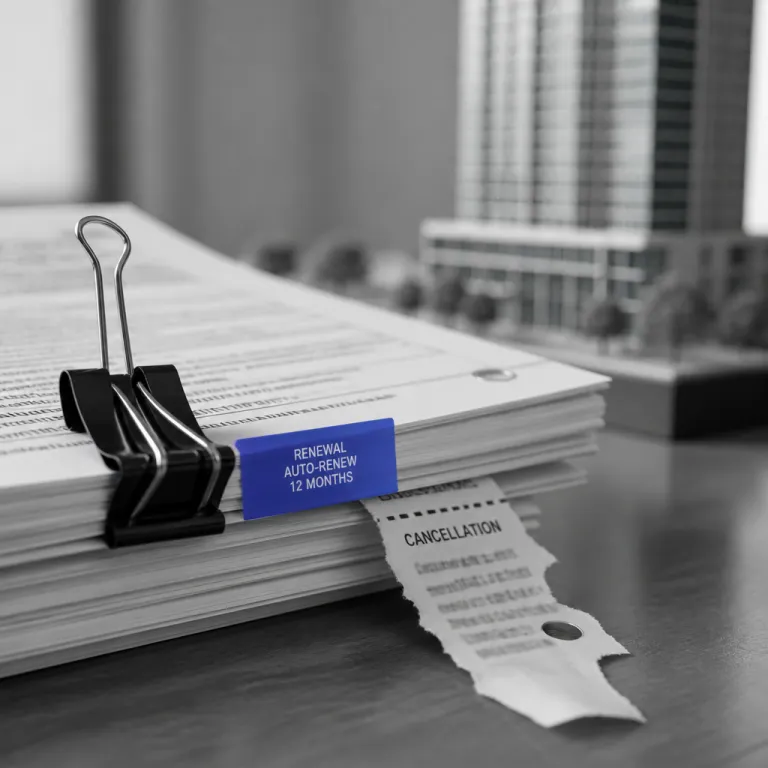
The hidden cost of auto renewal in UAE office contracts
In most UAE offices, contract management is treated as background noise. Yet the way you handle each contract lifecycle, especially every auto renewal, quietly shapes your annual spend more than many visible projects. For a senior office manager in DIFC, ADGM, or JAFZA, ignoring contract renewals is effectively signing a blank management contract with your vendors.
Across Dubai and Abu Dhabi, standard commercial agreements for facilities, SaaS, and equipment often include contract terms with 12 month cycles and 60 to 90 day notice periods. Miss that narrow window, and the contract lifecycle resets automatically, locking you into another full term renewal with the same price, scope, and obligations. This is where weak contract management and poor lifecycle management turn into structural overspend, not just a one off mistake.
The pattern is always similar in large offices with fragmented vendor management. A service contract for cleaning, a software contract for project tools, or a printer lease agreement starts as a tactical decision, then drifts into auto renewal without any structured performance review. Over three or four contract renewals, the office manager loses negotiation leverage, while the vendor’s management system quietly benefits from your lack of reporting analytics and contract data discipline.
Think about your own stack of contracts and service contracts right now. How many of those agreements were actively reviewed before the last contract renewal, and how many simply rolled over through auto renewal because nobody tracked the lifecycle dates ? When contract management is reactive instead of system driven, auto renewal becomes the default decision, and renewal decisions are made by the calendar, not by performance or strategy.
Building a contract register that actually works in UAE offices
The first serious step toward effective contract management in a UAE office is a live contract register. Not a forgotten Excel file on a shared drive, but a working management system that your équipe uses weekly to steer every agreement and service contract. For most offices, this single artefact transforms contract lifecycle chaos into a predictable workflow automation engine.
Your register should capture the full lifecycle management picture for each contract, not just the vendor name and price. At minimum, track vendor, contract start date, contract renewal date, notice period, annual spend, internal contract manager, contract terms summary, and whether the agreement includes auto renewal or explicit terms renewal. When you treat contract data as operational données instead of paperwork, you can finally link vendor management to performance, compliance, and budget control.
In practice, many UAE offices start with a shared spreadsheet as their first management software for contract lifecycle. Use clear columns, data validation, and color coded flags for upcoming contract renewals and renewal decisions, then connect it to calendar alerts in Outlook or Google Calendar. If your équipe struggles with messy vendor names or inconsistent software contract labels, use a structured procedure for cleaning and standardizing vendor product names so your contract data remains searchable and audit ready.
Once the basics are stable, you can graduate to lightweight contract management software without over engineering the system. Tools like Notion, Airtable, or a simple CRM style database can support workflow automation for approvals, reminders, and reporting analytics on contract lifecycle and service contracts. The goal is not a glossy dashboard ; it is a reliable contract management backbone where every agreement, management contract, and software contract is visible, dated, and owned by a named manager.
Quarterly contract reviews: a 15 minute discipline that protects your P&L
Auto renewal only hurts when nobody looks at the contract lifecycle before the notice period closes. A quarterly contract review ritual forces your équipe to connect contract management with real world performance, usage, and commercial leverage. Think of it as a standing operating procedure, not a one off clean up project.
For each contract and service contract, block 15 minutes in a quarterly review meeting and ask three direct questions. Are we still using this software, facility service, or equipment at the level assumed in the original agreement, and does the performance match what we pay ? Is the price and scope still competitive in the UAE market, based on at least two alternative vendor quotes or benchmarks for similar contracts and software contracts ? Does the current contract terms structure, including auto renewal, obligations, and compliance clauses, still fit our risk appetite and operational reality.
Document the answers as structured contract data in your management system, not as vague meeting notes. Tag each agreement with a simple decision code such as keep, renegotiate, or exit at next contract renewal, and link that to the renewal date and notice period. Over time, this creates a living reporting analytics layer on top of your contract lifecycle, showing where spend is justified by performance and where vendor management has drifted into legacy mode.
For larger UAE offices, this is where contract lifecycle management starts to intersect with people and productivity metrics. When you align contract management with a broader people analytics dashboard for office operations, you can link software contract usage to employee adoption, or cleaning service contracts to actual occupancy data. The outcome is sharper renewal decisions, fewer passive contract renewals, and a clear narrative for your CEO about how contract management protects both cash and operational performance.
Negotiation leverage in the UAE context: using data, not drama
In the UAE, landlords, facilities providers, and SaaS vendors expect negotiation as part of the commercial relationship. What they do not expect is an office manager who arrives with clean contract data, usage metrics, and a clear view of the contract lifecycle before any renewal discussion. That combination quietly shifts the power balance in every management contract and service contract conversation.
Start by pairing each contract with a simple one page negotiation brief inside your management software or contract management system. Capture the current contract terms, annual spend, performance issues, and at least two competitor benchmarks for similar contracts or software contracts in the UAE market. When you walk into a renewal meeting with this level of lifecycle management clarity, you are no longer reacting to vendor talking points ; you are steering the agreement based on facts.
Usage data is your strongest ally against lazy auto renewal and inflated contract renewals. For SaaS tools, pull login and feature usage reports to show whether the software contract still matches your équipe’s real activity, then propose a new agreement aligned with actual seats and modules. For service contracts such as cleaning, security, or maintenance, compare the original scope to current headcount, floor area in square metres, and operating hours, then challenge any mismatch between obligations and reality.
To keep this sustainable, embed negotiation checkpoints into your contract lifecycle and workflow automation. Set reminders 120 days before each contract renewal to update your negotiation brief, refresh competitor quotes, and validate internal satisfaction with the service. Over time, this habit turns vendor management from a reactive firefight into a disciplined process where every agreement, from a small software contract to a multi year management contract, is renewed on your terms, not by default auto renewal.
Choosing the right tools for contract lifecycle management in UAE offices
Many UAE office managers assume that serious contract lifecycle management requires heavy enterprise software. In reality, the right management software is the one your équipe actually uses consistently to track contract lifecycle, contract renewals, and renewal decisions. A simple but well governed management system will always beat an expensive tool that nobody updates.
For offices under 300 employees, a structured spreadsheet or Notion database can deliver robust contract management if you design it with clear fields and workflow automation. Use templates for new contracts that capture legal terms, commercial conditions, compliance requirements, and key obligations, then standardize how you log every agreement and service contract. Connect this to automated reminders for contract renewal dates, and use tags to distinguish software contracts, facilities contracts, and other management contracts for targeted reporting analytics.
Larger enterprises in DIFC, ADGM, or JAFZA may benefit from dedicated contract management software such as Juro or Concord, especially when legal and procurement teams share responsibility for vendor management. These tools centralize contract data, support approval workflows, and provide dashboards on contract lifecycle, spend by vendor, and upcoming contract renewals. Before you invest, map your current processes and define exactly how the system will improve compliance, reduce silent spend, and tighten control over auto renewal and terms renewal.
Whatever tool you choose, the real differentiator is data discipline and cross functional collaboration. Align legal, finance, and operations around a single source of truth for agreements, then use resources on optimizing supplier data for better operations to keep your contract data clean and reliable. When contract management becomes a daily operational habit rather than an annual clean up, your office stops leaking money through unmanaged auto renewal and starts treating every contract as a controllable P&L lever, not a sunk cost.
FAQ
How can I quickly identify risky auto renewal clauses in existing contracts ?
Start by scanning each contract for clauses mentioning automatic extension, auto renewal, or tacit renewal, usually near the term and termination section. Note the minimum contract duration, the length of each renewal period, and the exact notice period required to stop the next renewal. Log these details in your contract register so you can prioritize reviews for agreements with long renewal periods and short notice windows.
What is the minimum viable contract register for a UAE office ?
A practical minimum register includes vendor name, contract description, start date, end date, renewal date, notice period, annual spend, internal owner, and a flag for auto renewal. Add a short summary of key obligations and compliance requirements so you can assess risk quickly. Even this lean structure gives you enough visibility to plan renewal decisions and avoid accidental contract renewals.
How often should we review contracts in a fast growing UAE company ?
Quarterly reviews work well for most offices because they align with budget tracking and performance reporting cycles. High value or high risk agreements, such as major facilities contracts or core software contracts, may justify monthly check ins on usage and service levels. The key is to review each contract at least once before its notice period so you can decide whether to renew, renegotiate, or exit.
Who should own contract lifecycle management in a UAE office ?
In many mid sized companies, the office manager or head of operations acts as the practical contract manager for facilities, admin, and SaaS vendors. Legal and finance teams should still define standard contract terms, compliance rules, and approval thresholds, but day to day vendor management sits with operations. Clear ownership avoids gaps where auto renewal happens simply because nobody felt responsible for the agreement.
When does it make sense to invest in dedicated contract management software ?
Dedicated tools become valuable once you manage dozens of active contracts across multiple departments and free zones, and your manual tracking starts to fail. If you see repeated missed notice periods, inconsistent versions of agreements, or confusion about obligations, a centralized system can pay for itself through avoided silent spend. Evaluate tools only after you have defined your processes, fields, and review cadence, so the software reinforces good habits instead of masking weak ones.