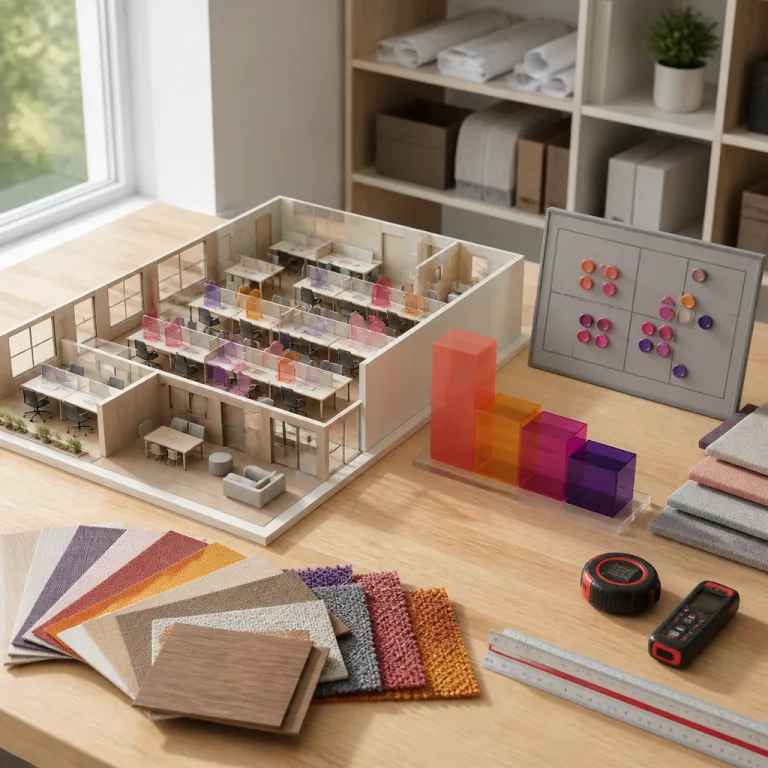
Why hybrid office floor plans in the UAE start with utilisation data, not décor
Hybrid office floor plan space utilisation in the United Arab Emirates is now an operational KPI, not a design afterthought. In a market where Dubai and Abu Dhabi office space is often leased years ahead, an office manager who still plans a workspace for full attendance will quietly erode margin every month. Your role is to translate hybrid work patterns into hard numbers that reshape the office layout, the office interior and ultimately the real estate line in the P&L.
Start by separating designed capacity from actual use of office spaces, because most UAE companies still sit on layouts drawn for a pre-hybrid workplace that assumed every employee at a fixed desk. Designed capacity is simple: it is the number of workstations, meeting areas and collaboration zones in the current office layout, while actual utilisation is the percentage of that space used in real time across a typical week. For a 1,000 square metre office in Dubai Internet City with 120 desks, you may find only 60 to 70 employees on site on peak days, and that gap is your negotiation leverage.
To measure hybrid office floor plan space utilisation in the UAE with credibility, combine three data sources rather than trusting landlord narratives. Badge access logs from your workplace security system show unique employee entries per day, while desk and room booking tools such as Condeco, Envoy or Robin reveal how different areas and layouts are actually used. A simple observation audit, done by the office manager or a small team twice a day for two weeks, validates whether collaboration spaces, focus zones and activity-based working areas match the patterns suggested by the technology.
Illustrative utilisation snapshot (anonymised UAE dataset)
| Metric (Dubai Internet City office) | Designed capacity | Observed peak | Average over 6 weeks |
|---|---|---|---|
| Workstations | 120 desks | 72 occupied (60%) | 54 occupied (45%) |
| Enclosed meeting rooms | 10 rooms | 8 in use (80%) | 5 in use (50%) |
| Open collaboration areas | 40 seats | 26 in use (65%) | 18 in use (45%) |
This kind of simple table, built from your own access and booking data, turns abstract hybrid work conversations into concrete space planning decisions.
Space ratios that work for hybrid working in UAE companies
Once you trust your utilisation data, you can move from vague hybrid working slogans to specific ratios for desks, rooms and collaboration areas. For most knowledge work teams in Dubai Media City, Abu Dhabi Global Market or Sharjah free zones, a desk-to-employee ratio between 0.7 and 0.8 is proving sustainable when hybrid work is properly governed. That means a 100 person team needs 70 to 80 workstations in the office, not 100, provided the office design supports both focus work and real-time collaboration.
Meeting room ratios also need to shift, because hybrid office layouts overloaded with eight-person rooms waste space and hurt productivity. A practical benchmark for UAE organisations is one enclosed room per 8 to 10 employees, with at least half of those rooms sized for two to four people to support quick collaboration huddles and remote work calls. Layer in two to three phone booths or acoustic pods per 1,000 square metres of workspace, and you create an environment where both on-site and remote employees can work without constant noise conflicts.
Quick reference: hybrid space planning ratios
| Space type | Recommended ratio | Notes for UAE offices |
|---|---|---|
| Desks | 0.7–0.8 per employee | Can move to 0.6 for highly mobile teams with strong hybrid governance |
| Enclosed meeting rooms | 1 room per 8–10 employees | At least 50% of rooms sized for 2–4 people for calls and quick huddles |
| Phone booths / pods | 2–3 per 1,000 m² | Support confidential conversations and neuroinclusive working |
| Quiet / focus seats | 20–30% of total seating | Helps balance collaboration with deep work in open-plan layouts |
Quiet zones and activity-based working areas are no longer a luxury in a hybrid office; they are a compliance and retention tool when an estimated 15 to 20 percent of your workforce may be neurodivergent, according to global studies on autism and ADHD prevalence (for example, research summarised by the UK National Autistic Society and the U.S. Centers for Disease Control and Prevention). WELL v2 aligned office interior design in Dubai is already pushing for acoustic zoning, controllable lighting and movement-friendly layouts, and these standards map directly to better space planning ratios. If you want a concrete reference point for layout design and space utilisation strategy, study how global buildings are rebalancing collaboration spaces and focus zones, as illustrated in this analysis of workspace strategies that can inspire Arabian Emirate office managers.
Hot desking, booking rules and the cultural realities of UAE workplaces
Hybrid office floor plan space utilisation in the UAE fails when hot desking is treated as a software rollout instead of a behaviour change programme. Office managers in United Arab Emirates companies know that employees value personal territory, especially in long-tenure teams where family-style workplace culture is strong. The goal is not to erase that culture, but to move it from fixed desks into shared collaboration spaces, transparent booking rules and reliable storage.
Start with a clear zoning map that separates quiet work areas, collaboration zones and social spaces, then apply hot desk policies only where hybrid work patterns justify it. For example, client-facing sales and consulting teams that spend three days per week in the field can share an activity-based working zone with a 0.5 desk-to-employee ratio, supported by lockers and digital booking tools. Back office finance or compliance teams with sensitive data may keep assigned seats, but still use shared collaboration rooms equipped with stable technology for remote work calls.
Policy without enforcement is theatre, so write a one-page hot desk standard operating procedure that covers booking windows, no-show rules, clean desk expectations and escalation paths. Use simple language in both English and Arabic, and link it to your HR and performance frameworks rather than vague engagement goals, while aligning with Ministry of Human Resources and Emiratisation (MOHRE) guidelines on working environment and employee dignity. When you present this hybrid working governance to leadership, connect it to revenue by showing how better space utilisation supports growth functions, just as a fractional sales manager can transform a sales strategy in the Arabian Emirates by reallocating resources where they actually convert.
Sample one-page hot desking SOP (template)
Scope: Applies to all shared desks and collaboration zones in Dubai, Abu Dhabi and Sharjah offices.
1. Booking rules: Desks can be reserved up to three working days in advance, for one day at a time. Bookings auto-cancel if the desk is not checked into within 30 minutes of the start time.
2. No-show and overstay: More than three no-shows in a month triggers a reminder from the line manager. Employees must vacate hot desks within 15 minutes of the end of their booking if another user is scheduled.
3. Clean desk expectations: At the end of the day, no personal items remain on shared desks. All documents and devices are stored in lockers or mobile pedestals to protect confidentiality.
4. Privacy and conduct: Sensitive client calls are taken only in enclosed rooms or phone booths. Activity-based working zones are treated as semi-public areas, with respectful noise levels and no recording without consent.
5. Escalation: Repeated breaches are escalated from team lead to HR, in line with MOHRE-aligned disciplinary procedures and the company’s code of conduct.
Fit out priorities landlords will not optimise for you
Landlords in Dubai, Abu Dhabi or Sharjah will happily show you glossy office interior design renders, but they will not optimise hybrid office floor plan space utilisation in the UAE for your specific workflows. Their incentive is to lease more square metres, not to right-size your office space or refine your office layouts for productivity. Your incentive, as the operations lead, is to invest fit out budget where it improves hybrid work outcomes and reduces long-term real estate exposure.
Shift spending away from oversized receptions, long corridors and underused executive offices, and redirect it into technology-enabled collaboration spaces and robust acoustic engineering. Every hybrid office should have at least one room per floor fully equipped for remote work meetings, with dual screens, ceiling microphones, reliable cameras and simple tools that employees can operate without IT support. WELL v2 and neurodivergent-inclusive design principles are useful here; prioritise indirect lighting, adjustable task lights, varied seating and temperature zoning across different areas of the workspace.
Biophilic interior design is no longer just an aesthetic trend in the UAE, because it now links directly to ESG narratives under the UAE Net Zero by 2050 strategic initiative and to measurable employee productivity in peer-reviewed research (for instance, studies published in journals such as Building and Environment and Journal of Environmental Psychology that associate access to natural elements with improved cognitive performance and reduced stress). Integrate plants, natural materials and views into your layout design, but do it with maintenance in mind, using species and irrigation systems that facilities teams can support without constant vendor visits. When you evaluate fit out proposals, score each line item against three criteria — impact on space utilisation, impact on hybrid working experience and impact on long-term operating cost — and reject anything that only improves the brochure.
Using utilisation data to renegotiate leases and run the office like an operating asset
Hybrid office floor plan space utilisation in the UAE becomes financially powerful when you use it to challenge lease assumptions, not just to rearrange furniture. Once you have six to twelve weeks of real-time utilisation data from access systems, booking tools and observation audits, you can model different office layouts and space planning scenarios with confidence. For example, you may find that a 1,200 square metre office in Jumeirah Lakes Towers is running at 55 percent peak utilisation, while a revised layout with more collaboration spaces and fewer fixed desks could deliver the same capacity in 900 square metres.
That 300 square metre delta is your negotiation anchor when the lease renewal hits, because you can show the landlord hard numbers on how your team actually uses the workplace. You can propose a smaller office space with a higher fit out quality, or push for more flexibility in the lease term, service charges or expansion rights in the same building. In some cases, you may keep the same footprint but reallocate underused areas into revenue-adjacent functions such as client training rooms, content studios or fractional subleases to trusted partners, always within free zone regulations.
To run this like a disciplined operating function, build a monthly utilisation dashboard that tracks occupancy, desk booking ratios, meeting room usage and noise complaints per area. Connect these metrics to HR data on retention and to finance data on cost per employee, and review them in the same cadence as sales and cash flow, because the workplace is now a lever, not a backdrop. For a deeper view on how AI and automation can support this governance, study this guide on AI transformation in the UAE office from pilot to daily operations, and treat space utilisation as another operational dataset, not a vibe survey, but a P&L line.
FAQ
What is a realistic desk to employee ratio for hybrid offices in the UAE ?
For most knowledge-based UAE companies, a realistic desk-to-employee ratio in a hybrid office is between 0.7 and 0.8. This assumes clear hybrid work policies, reliable booking tools and a mix of focus and collaboration spaces in the office layout. Teams with high remote work intensity or frequent client visits can sometimes move closer to 0.6, but only with strong governance.
How can I measure space utilisation without expensive software ?
You can measure space utilisation using three low-cost methods that still meet executive scrutiny. First, export badge access logs from your building or office security system to track daily headcount and peak times. Second, run a manual observation audit twice a day for two weeks, counting occupied desks, meeting rooms and collaboration areas on a simple spreadsheet.
How should hot desking policies handle personal storage and privacy ?
Effective hot desking policies in the UAE always pair shared desks with reliable personal storage and clear privacy rules. Provide lockers or mobile pedestals for each employee, and define what can be left on desks at the end of the day. For privacy, reserve some enclosed rooms for sensitive calls and ensure that activity-based working zones are not used for confidential client discussions.
What fit out elements have the biggest impact on hybrid productivity ?
The fit out elements with the highest impact on hybrid productivity are acoustic treatment, meeting room technology and zoning of different work areas. Acoustic panels, carpets and ceiling treatments reduce noise conflicts between focus work and collaboration discussions. Well-equipped video rooms and clearly marked quiet zones help both on-site and remote employees work without friction.
How can utilisation data support lease renegotiation with landlords ?
Utilisation data supports lease renegotiation by showing exactly how much office space you truly need for your team. When you present peak occupancy, desk usage and meeting room utilisation in clear charts, you can justify a smaller footprint, better terms or a different office layout within the same building. Landlords respond to numbers, and space planning metrics give you those numbers in a language they understand.